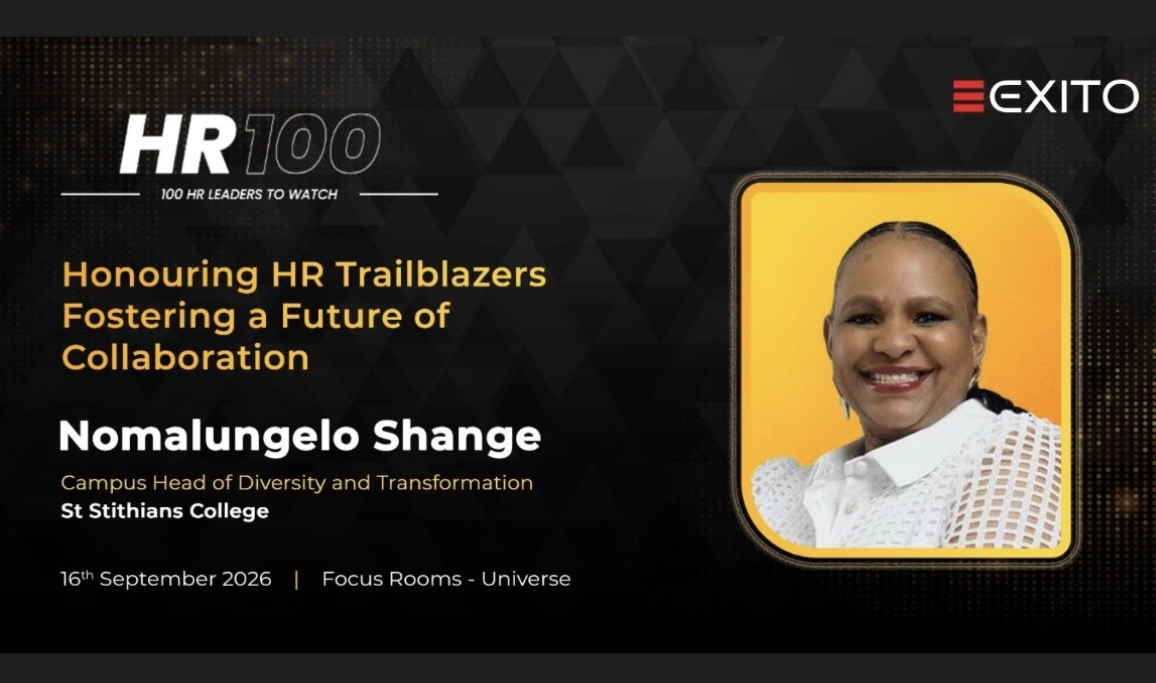



A School Among Workplaces: Noma Shange and the HR100
The programme is demanding by design. Nominations come from professionals across industries and must be supported by evidence of impact. Independent research then tests and extends them. From hundreds of submissions, 100 people are chosen.
We congratulate Noma warmly. Her recognition also carries a second meaning that deserves attention in its own right.
For the first time, a school
Lists like this one usually read like a directory of corporate South Africa: banks, mining houses, retailers and multinationals. This year, for the first time, one of the leaders recognised works in a school. The award belongs to Noma, but through her the programme has placed a school's people practice alongside those of the country's largest employers. It has judged that work to be of national significance.
This matters less for what it says about St Stithians than for what it says about schools. A school is a workplace. It employs teachers, coaches, administrators, grounds staff and many others, and it has the same duties as any employer to treat them fairly and to help them grow. A school is also where young people first learn what institutions expect of them and what those institutions owe them in return. The habits a school models, such as how it handles difference, disagreement and belonging, go with its pupils into the workplaces of the next forty years.
South Africa tends to discuss education and employment as separate problems. On this view, schools produce and the economy absorbs. In practice they are one system. The country's human and socio-economic challenges will not be solved in boardrooms alone, and they will not be solved in classrooms alone. A national HR programme that looks to a school for leadership is acknowledging this. The common good depends on the whole chain, from the classroom to the career, and every part of that chain deserves serious attention.
The work itself
Noma has long championed Diversity, Equity, Inclusion, Belonging and Transformation at the College. Her approach has never been limited to policy or compliance. She treats transformation as something people must be able to feel in the everyday life of an institution: in who is heard, who is supported and who feels that the place belongs to them. That kind of change is slow. It depends on hard conversations held with care, and on the patience to keep going after the first round of goodwill has faded. It is also the kind of work that is easy to praise and hard to do.
No one achieves alone
Noma would be the first to say that recognition like this is never the work of one person. It reflects a College leadership that chose to put transformation at the centre of its strategy rather than at its margins. That leadership gave the work real authority and resources, and accepted that such work would sometimes question the institution itself. It reflects colleagues, pupils and families who took part in those conversations in good faith. There is a Nguni phrase for this, umuntu ngumuntu ngabantu: a person is a person through other people.
Supportive conditions, however, are not the same as achievement. What Noma has made of them is her own, and her rigour, persistence and courage have been exceptional. The College made the space, and she did the work within it.
An invitation
We do not take this recognition as a sign that St Stithians has arrived. Transformation is unfinished work, and many schools across the country do it with great commitment. We take it instead as an invitation. Schools can treat their people practice as work of national consequence. Employers can see schools as partners in the country's future, not simply as suppliers of its workforce.
Congratulations, Noma. This is richly deserved, and we are proud to count you among the Saints.